Posts

Showing posts with the label Landscape

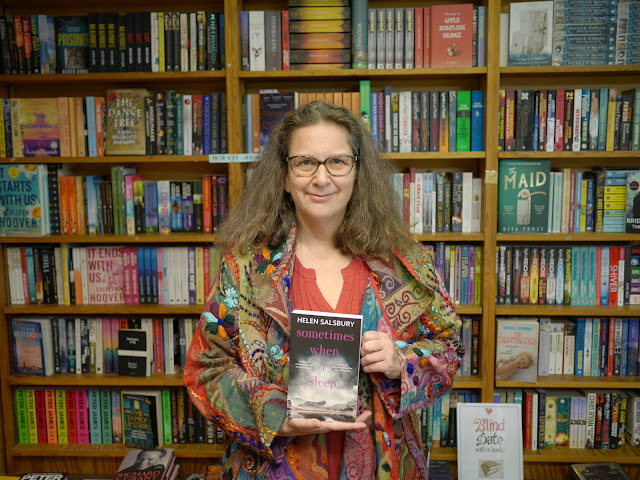
PAC Interview: Helen Salsbury
Image
  Portsmouth and its environs have inspired an impressive number of well-known writers over the years, and the area continues to be a hub of creative activity for writers of every persuasion.  The Portsmouth Authors Collective was created to promote the work of the city’s current crop of authors, and this series of interviews offers a glimpse into what they're doing. Author Bio: Helen Salsbury’s debut novel, Sometimes When I Sleep , was published in 2021. Her fiction has been published in anthologies, and shortlisted and longlisted for a number of prizes, including the Mslexia novel competition. She’s a trained community journalist and the founder of the environmental writing platform Pens of the Earth . ~ Loree: We’ve known each other for a number of years now, and have exchanged feedback on our WIPs from time to time, but I don’t know a great deal about your journey as a fiction writer. When did you begin writing stories? Helen: I have a box in the attic of the st...
The Stories We Tell Ourselves: Exploring Western American Identity, Pt 3

Image
photo by Karen Murray Belonging  to the Land The people we become – both in the sense of how we see ourselves and how others see us as individuals – depends on a multitude of influences: the families we are born into and our positions within those families; the friends we choose; our education; our employment; our political and religious beliefs; and the experiences we have in life are just some of the factors that shape our identity.  A few of these factors are constant and unchangeable: most of us will remain the same gender throughout our lives, for example, and regard ourselves as being a particular nationality or race.  Other factors, such as family position, education and occupation, and even political and religious beliefs, can change periodically through a natural process of maturation and individual development.  Others, still, may change numerous times during the course of our lives as our interests change and our attachments and allegiances shi...

The Stories We Tell Ourselves: Exploring Western American Identity, Pt 2

Image
The Quest for Native Identity Before any discussion of Indian identity can take place, one needs to ask what , exactly, is ‘an Indian’?  Hilary Weaver sets out the complexity of the Indian identity discussion: There is little agreement on precisely what constitutes an indigenous identity, how to measure it, and who truly has it.  Indeed, there is not even a consensus on appropriate terms.  Are we talking about Indians, American Indians, Natives, Native Americans, indigenous people, or First Nations people?  Are we talking about Sioux or Lakota?  Navajo or Dine?  Chippewa, Ojibway, or Anishnabe?  Once we get that sorted out, are we talking about race, ethnicity cultural identity, tribal identity, acculturation, enculturation, bicultural identity, multicultural identity, or some other form of identity? (Weaver 2001:240) The mixedblood Indian writer Hertha Dawn Wong identifies two key features which distinguish the Native American concept ...

The Stories We Tell Ourselves: Exploring Western American Identity, Pt 1

Image
The Shaping of a Western Identity photo by Karen Murray In June 2010, The Crab Creek Review sparked debate on a number of academic blogs about the validity of regional classifications of contemporary writers when it published an interview with the novelist David Guterson.  Responding to a question about ‘Northwest writers’, Guterson, who was born and has spent most of his life in Seattle, and whose novels are mostly set in the city and its Northwest environs, was vociferous in refuting regionalism as a valid contemporary concept: There might have been a time when geography and culture converged in such a way as to make the regional identification of artists a worthwhile practice…. Today, with the exception of the handful of essentially isolated cultures remaining on the planet, human beings have a limited relationship to place, and this is, of course, reflected in the arts.  To be a ‘Northwest writer’ in the 21 st century simply means that, like billions of peo...