Posts

Showing posts with the label Lewis and Clark

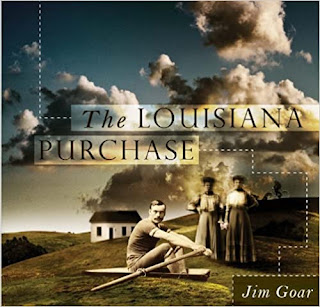
Review: The Louisiana Purchase by Jim Goar
Image
When historical research is used to recreate the past on the page, it can offer us a view into a vanished world. It can educate us about facts while entertaining us with narrative. When historical research is used creatively, by exploring what is not known as well as what is, it can offer powerful insights not only into the past but also into our contemporary world. As a PhD student engaged in the creative use of research into the history of the American West I came eagerly to Jim Goar’s  The Louisiana Purchase (sadly now out of print).  In the Author’s Note at the front of the book Goar sets the context for what follows: at the beginning of the nineteenth century, the United States acquired that portion of the continent, south of British-held territories, which at its widest point extended from the Mississippi River to the Rocky Mountains. Commonly known as the Louisiana Purchase , this vast area of some 820,000 square miles was largely unexplored. In 1804, American Presid...

Quotes from Chief Joseph

Image
I’ve recently been re-reading Chief Joseph’s account of the Nez Perce War and subsequent internment in Indian Territory, and like many before me have been struck by the eloquence and power of his words. Whether this eloquence comes directly from Joseph himself or from the transcriber hardly seems to matter. The power behind the words is Joseph’s. I am also struck by the continuing relevance of his words and how they mirror so much of what we tend to think of as ‘modern democratic values’ and Christian teaching.  +++++++++++++++++++++++++++++++++++++++++++++++++++++++++++ Chief Joseph: Hin-mah-too-yah-lat-kekt / In-mut-too-yah-lat-lat  (Thunder Rolling Down the Mountain) Our fathers gave us many laws, which they had learned from their fathers. These laws were good. They told us to treat all men as they treated us; that we should never be the first to break a bargain; that it was a disgrace to tell a lie; that we should speak only the truth; tha...

Ten Events That Shaped the West

Image
Here's an article from True West Magazine , published in February 2007. It lists some of the events of the frontier era of American history which the author points to as helping to shape not only the country but also the identity of the American people.  It's disappointing, but not surprising, that the list focusses almost exclusively on events that reinforce the heroic myth of Manifest Destiny and western expansion.  The one exception is The Battle of Little Bighorn - but even here the author manages to give a sympathetic account of Custer's defeat:  ‘…the weapons the soldiers were issued were single-shot Springfield trapdoors with copper casings that jammed, while many of the warriors had armed themselves with lever-action Winchesters.’   In effect what he’s saying is that the Indians, by being better armed, weren’t playing fair.   It makes a change, but I’m still not going to shed any tears over the 7 th Cavalry, I’m afraid. Gen. George Armstrong...

Filling in the Gaps in the Corps of Discovery Journals

Image
Numerous works of western fiction have drawn inspiration from the Lewis and Clark journals since their official publication in 1814.  Most, such as Vardis Fisher's Tale of Valor (1960) and Brian Hall's I   Should Be Extremely Happy In Your Company (2003) have attempted to fictionalise what is known about the expedition, relying on the journals to structure the narrative and provide the bones of character development while relating the story of the expedition from the perspective of one or more real life members of the party.  James Alexander Thom's Sign Talker (2000) tells the story from the viewpoint of George Drouillard, the Corps’ half-blood Shawnee interpreter, while Anna Lee Waldo's Sacajawea (1978) and Diane Glancy's Stone Heart (2003) present the story from the point of view of the expedition's only female member.  Others, such as Will Henry's The Gates of the Mountains (1963), present the story from the point of view of a fictional character plac...

Gathering historical research on William Clark's Nez Perce son

Image
During the past year, I have been attempting to gather all available information about William Clark’s supposed Nez Perce son, variously known as Tzi-Kal-Tza, Halahtookit, Al-pa-to-kate, Daytime Smoke(r), and Son of Daytime Smoker. The name I find the most poignant, however, the name that links into my research on personal identity, is the one he is said to have called himself – Clark (Moulton, vol 7, p 241). * The idea for my project started to emerge about ten years ago, when I visited the Nez Perce Historical Museum in my hometown of Lewiston, Idaho. Among the exhibits were collections of artifacts from early white settlers, the Nez Perce tribe, and the Lewis and Clark expedition which passed through the region twice: in September 1805, on their way to the west coast; and in May 1806, on their return journey to St. Louis. As I grew up in Lewiston, I thought I knew the history of the area fairly well, but tucked into a display of beaded gauntlets and stone tools was a piece of i...