Posts

A Review of 2010

Image
Ethel Louise Mabry The end of another year is upon us and I am reminded of my grandmother’s claims that time speeds up as one gets older. As a kid, in Idaho, I was dumbfounded by this idea. Science was never my strongpoint, but I knew, somehow, as the interminable years of my childhood wore on that such a statement must go against some law of physics. ‘Don’t go wishing your life away,’ she’d tell me as I itched to break free of high school classrooms, anxious to join the world outside my small town. Even in grade school, at the age of nine or ten, I kept track of the school days, crossing them off one by one, willing each of them into the past so that I could be released into the freedom of summer. I was in a hurry to be somewhere else, do something new, start living my life. Anxious for time to pass. Grandma was right, of course. She always was. Time does speed up as a person gets older. It’s a fact. Physics be damned! And though I always find myself feeling sombre at the c...

An exploration into developing a set of marking conventions for creative writing

Background Almost uniquely amongst academic studies, the Creative Arts are notoriously difficult to assess. Unlike other subjects, they are not about the learning of facts or the expression of theories, and consequently, they cannot be assessed using traditional methods of exams and essays. In Creative Writing modules, work must show an understanding of techniques and an understanding of the effects those techniques have upon the reader. It is a practical skill which can only be assessed by its final product—a piece of written text structured to achieve a desired purpose. Creative Writing students frequently, and occasionally even tutors, argue that assessment stifles creativity and that writing, as a form of self-expression, should not come under the usual sets of criteria given to other, more prescriptive subjects. Critics of assessment claim that Creative Writing cannot be judged objectively, as assessors will automatically be biased against any work whose style or subject matte...

Rambles and Writing

Image
Between the end of May and the start of October, I had the dubious luxury of unemployment - not official unemployment which requires one to be seeking paid work, but the off-the-books kind of unemployment which doesn't show on government statistics and makes no demands apart from economic miserliness. Having spent the past few terms teaching, in one capacity or another, I greeted the summer as an opportunity to concentrate on my novel. Ahead of me stretched three, maybe even four student-less months, during which I could, if I remained focussed, bang out the rest of my first draft in a mere 625 words a day. I had counted them, the words, one by one, then grouped them into doable, bit-sized chunks. I had a plan and it sounded so easy. The first few weeks of my unemployment went blissfully well as I knuckled down to my new routine. Being a natural early riser, I relished my quiet mornings at the keyboard, a jug of thick Arabica at my elbow and a full day of uninterrupted writing ah...

Thresholds: home to the international short story forum

Image
I am pleased to annouce that Thresholds is now up and running. Please register here and have a look around the site. Thresholds is the only online forum dedicated to the writing, criticism and study of the Short Story. Undergraduate students are welcome to join the forum as Associate Members, with access to our extensive resource lists, articles, interviews and our student-led blog. Postgraduate students are invited to join our team of bloggers and contribute to a wide variety of discussions about academic life, their own research and writing projects, and literary news. We will also run student-led writing workshops, and provide opportunities for peer review. Our inaugural edition contains an exclusive interview with the internationally acclaimed writer Hanif Kureishi who discusses his recently published Collected Stories . In October, we will host our first live Question & Answer session with Adam Marek , author of the weirdly wonderful collection Instruction Manual for S...

The College and University Scramble for PhD Funding

On Tuesday, this week, I went to a seminar in London about locating funding possibilities for Creative Writing PhDs.  What I learned was not good.  At least not for me.  The already slim opportunities that exist for Arts and Humanities research are now anorexic, and I emerged from the session kicking myself for having wasted £30 on the train fare simply to confirm what I already suspected: it's very unlikely I will receive funding because - like most postgrad Creative Writing students - I have not followed the traditional (i.e. preferred ) academic route.  To be honest, rather than traipsing all the way to London for this news, it would have been less expensive and more convenient if I had just gone to  Online PhD  or one of the other online sites offering information and advice to postgraduate students.   In short, this is what I learned: f unding bodies such as the Arts and Humanities Research Council like to play safe and...

Where's the Summer Gone?

It’s been a very short, very intense summer here in Portsmouth (not to mention, a very damp and grey one) and though I feel I’ve made good progress on a number of projects, I have sorely neglected my blogging responsibilities, here. Summer, for me, began when my temporary teaching post at Portsmouth College came to an end in late May and I was finally able to get down to some serious writing. For six solid weeks, I faithfully kept my commitment to work on the novel from 9 a.m. to 6 p.m., five days a week. That period of frenetic activity came to an end after the first week of July when I went on a three-week bike ride in France. My big plans for continuing to work on the novel, in the tent each evening, came to naught. All I really wanted to do at the end of a long day’s ride was to eat and crawl into my sleeping bag. On my return, at the beginning of August, my attention turned, not back to my own novel, but to a collection of short stories by the American writer, Belle Boggs....

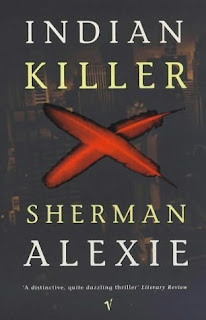
A Discussion of Sherman Alexie's novel, Indian Killer

Image
          A year after the acclaimed Reservation Blues , Sherman Alexie’s second novel, Indian Killer received reticent praise when it was published in 1996. It is a book which he, himself, seems both drawn to and repelled by. In a 2002 interview with Duncan Campbell, Alexie states ‘It’s the only one [of my books] I re-read. I think a book that disturbs me that much is the one I probably care the most about’ 1 . He has expressed dissatisfaction with it, artistically, describing it as a failed mystery novel and ‘pretentious’ for its literary ambitions 2 . Maya Jaggi writes that he has now distanced himself from the novel and feels ‘overwhelming disgust’ [Alexie’s words] towards the violence portrayed 3 . Apparent in Reservation Blues , his previous collection of short stories The Lone Ranger and Tonto Fistfight in Heaven , and his poetry, Alexie’s own rage rises to its peak in this novel, with an outpouring of fictional vengeance for historic...